A Blue Sky Strategy for CPTED: Applying CPTED Principles to Counter Unmanned Aerial Systems
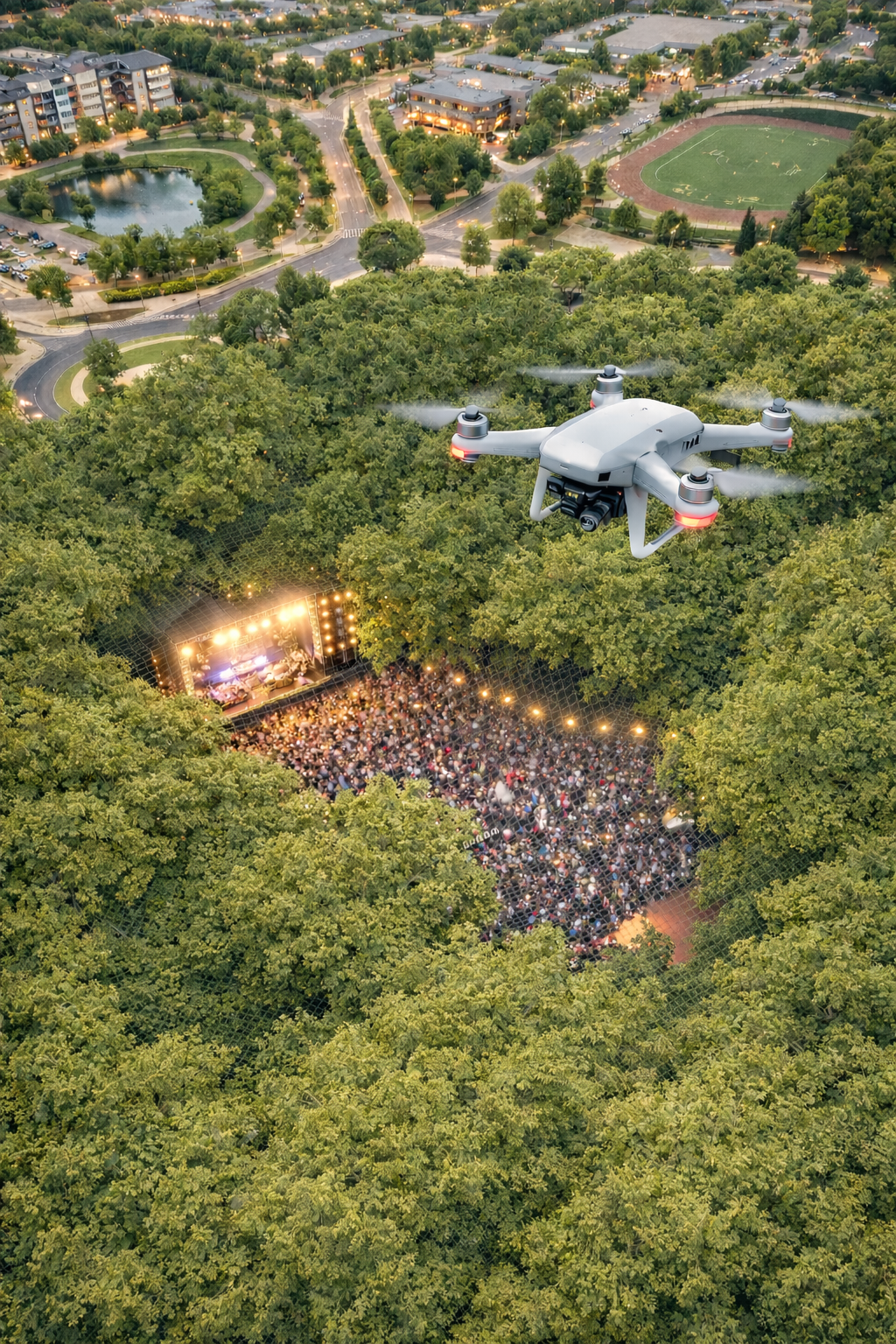
CPTED may be one of the answers to countering the threat from drones. AI generated.
This article proposes applying Crime Prevention Through Environmental Design (CPTED) principles to counter the unmanned aerial systems (UAS) threat, an intersection that remains largely unexplored in existing counter-UAS research.
I am a huge proponent of Crime Prevention Through Environmental Design (CPTED). Ever since I learned about the theory, I knew it was something I wanted to become fluent in. I eventually obtained my CPTED Practitioner designation from the state of Florida and have become an even bigger proponent for this way of looking at the world around us.
Another topic I have become entranced by is countering the threat posed by small commercial drones to our communities here in the United States. After studying this threat, it has also changed the way I look at the world around me. In my search for the answers to counter this emerging threat, I found what appears to be a gap in knowledge, using CPTED to counter the drone threat.
What Is CPTED?
For those of you unfamiliar with the concept, CPTED is the idea that with proper design of the built environment we can reduce crime and the fear of crime. Concepts like open sight lines, proper lighting, manicured landscaping, ease of use, and connection to the community are some of its core pillars. This idea has spread across the world after being first formalized at my alma mater, Florida State University, in the 1970s. There is now an ISO standard for CPTED (ISO 22341:2021). Disney has never officially said they use the concept, but anyone who has ever visited can tell the principles guide their design choices. Organizations like the FBI use CPTED to design their buildings and spaces. It is a widely accepted and applied framework.
Why Are Drones a Different Kind of Threat?
Drones, or unmanned/uncrewed aerial systems (UAS) if you are a nerd like me, are not as well established as a security threat as the four pillars of CPTED are as a solution. However, since the wide use of commercial off-the-shelf (COTS) UAS in almost every armed conflict since the 2010s, companies and governments, big and small, have been scrambling to find a solution to these buzzing demons. Especially since the frozen battlefields of Ukraine have proven their effectiveness beyond a shadow of a doubt, at least for now. Billions of dollars, and in some cases the blood of brave Ukrainians, have been spent figuring out what technology and procedures work best against them.
What Is the Gap in Counter-UAS Research?
In all of the research I have done, the intersection of CPTED and counter-UAS (CUAS) remains largely unexplored, particularly in the peer-reviewed literature. Others have noted that CPTED assessments should account for the drone threat. This post takes that a step further, asking what specific CPTED principles can offer as physical countermeasures against hostile UAS right now. This is a significant gap in CUAS research. It is a stone that should be turned over. Flying a payload over a location from a distance is something criminals, terrorists, and state actors are going to covet and use for years to come, regardless of doctrinal changes on the battlefield.
After spending considerable time thinking about this problem (ask anyone who knows me, they can confirm), here is where I would start. Any feedback is appreciated and, at this point, would move the conversation forward.
Netting
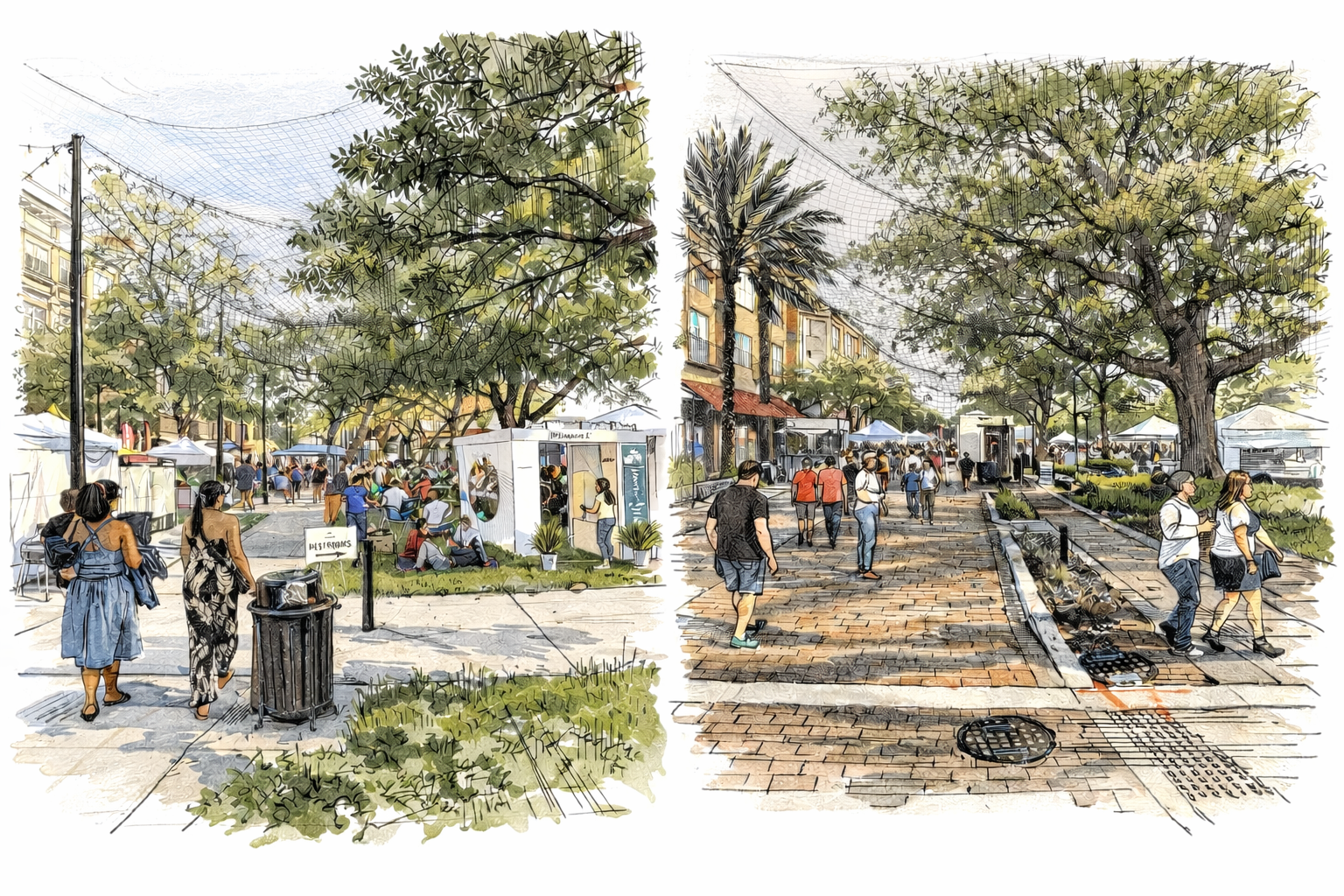
AI rendering of potential CPTED counter drone options for a street gathering.
Ukraine has become one of the top consumers of netting in the world because of its effectiveness at stopping UAS. Placing netting above places where people gather would stop a drone from flying into the location while still providing good natural surveillance, because it does not block sight lines. It would also increase territorial reinforcement and access control by providing an architectural cue that delineates private space from public space. Maintenance will be an issue, since the netting currently available is prone to tears and will need periodic cleaning. One of the biggest downsides is that it does not blend in. It is overt security, which CPTED tends to downplay. An emphasis might be on selecting netting that is a tighter weave, like what is used at hockey rinks around the goal to protect spectators from errant slap shots while also minimally interfering with their view of the action.
Tree Canopies
If trees with wide, high canopies are planted over a location where people gather, they may provide shielding from COTS UAS. A common tactic observed in Ukraine is soldiers moving into the wood line once a drone is detected, because it is very difficult to fly through trees. If branches cover most of a location, it could prevent a drone from coming in directly overhead. This would also shield sight lines from the sky, which I think is acceptable. Open sight lines are meant for legitimate users and observers to monitor a space for abnormal behavior. At this point, there are very few legitimate observers who need a line of sight from the air. Law enforcement could need to see in, but if they do, they will find another way or send officers to that location. Thermal imaging can still cut through a forest canopy. While this does not completely prevent a drone in the hands of a skilled pilot, it might force someone to reconsider, displace the crime to a different location, or think twice altogether. The use of trees in CUAS may also be a great tool because the maintenance is relatively straight forward, they have been used by CPTED practitioners for years, and they are not an overt sign of security.
Lighting
There may be a need to do the unthinkable: point the luminaires skyward. Before anyone from the dark skies initiative comes for me, let me explain. If there is a report of an incoming drone at night, one possible counter is to blind it with light. This will not stop a GPS-guided, autonomously piloted drone from reaching its target, but it could stop a first-person view (FPV) UAS with a poor-quality camera piloted by a criminal. While modern FPV cameras have improved, sudden high-intensity light can still cause exposure overload, forcing a pilot to reorient before reacquiring the target. A practical solution could be fixtures with the ability to quickly switch from full cutoff to no-cutoff mode. Going from a full cutoff fixture to one with the glare of an infamous acorn fixture could dazzle a drone pilot and make hitting a specific target significantly more difficult.
Finding the Pilot: Go Aftedr the Archer, Not the Arrow
One of the core approaches to CUAS is the idea of going after the archer, not the arrow. We should be working with businesses, organizations, and residences located around a possible target and preaching the principles of CPTED. If a surreptitious pilot can be more easily observed, or cannot find a suitable launch point, the mission becomes harder and may not happen at all. It sends a signal that this area means business. If someone tries to fly, they will be reported and caught.
I sincerely hope this is the beginning of more research into the intersection of CPTED and CUAS. We must exhaust every option. We may be able to protect what's important to us with well-placed trees or luminaires, but it appears very few have looked to the CPTED movement for answers. Turning over this stone is a worthwhile exercise in the counter-drone fight.
Daniel Holland is the co-founder of Crisis Prevention and Response (CPR), a security consulting and training firm that delivers practical security solutions to homes, businesses, schools, houses of worship, and other organizations. He is an active law enforcement officer with over 10 years of experience in investigations, crime prevention, and public safety. He holds Florida Crime Prevention Practitioner and Florida Crime Prevention Through Environmental Design (CPTED) Practitioner designations along with FBI-LEEDA Public Information Officer certification at both levels. He also specializes in emerging threat assessment, with a focus on the drone threat landscape and its implications for civilian organizations.