The Triangle Doesn't Lie: Why a Drone Attack on US Soil Is a Matter of When
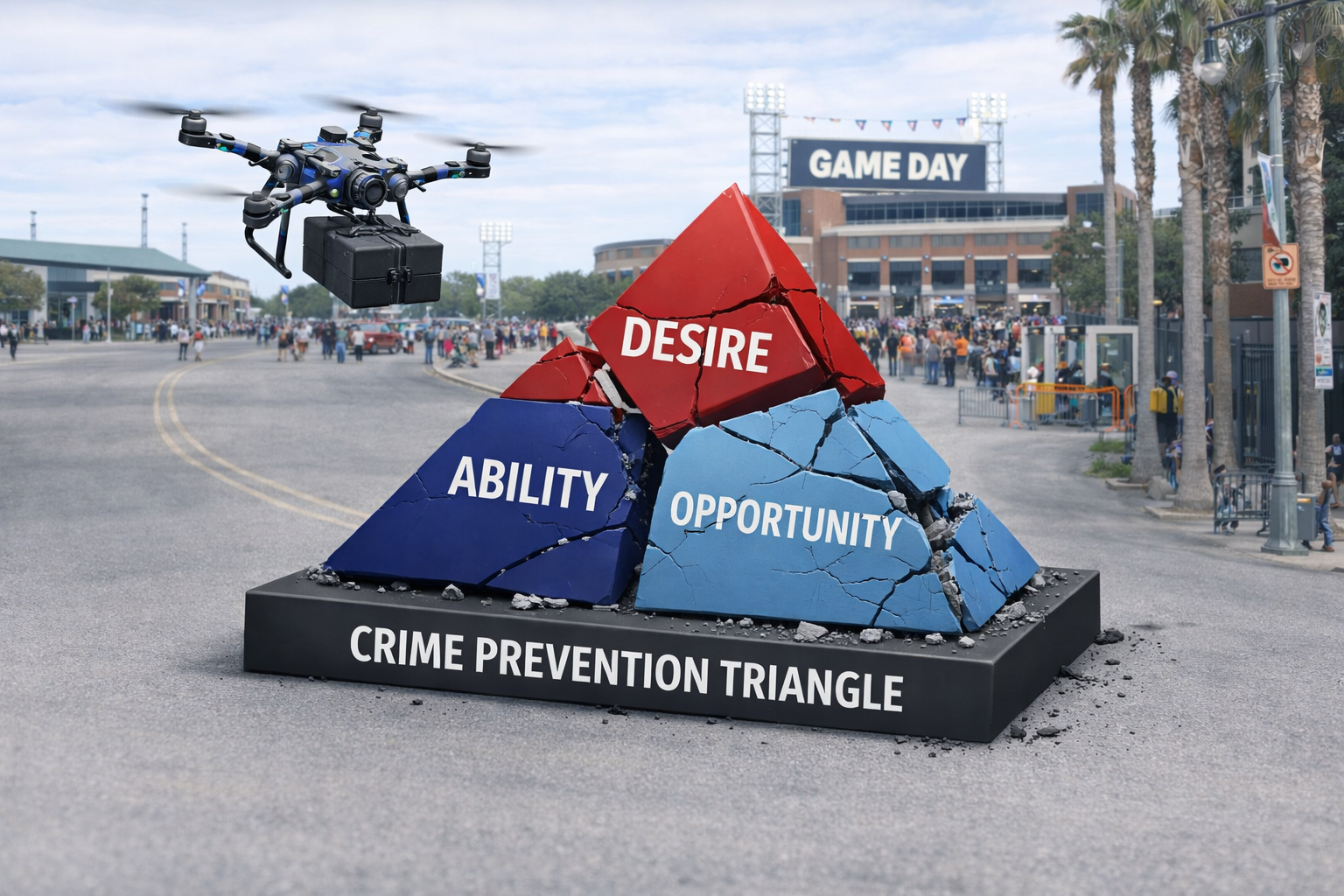
The Crime Prevention Triangle may have met its match if something does not change. AI generated.
Applying the Crime Prevention Triangle to the civilian drone threat, this post argues that a malicious drone attack on a U.S. civilian target is a matter of when, not if, because all three required elements, Desire, Ability, and Opportunity, are already present.
In my previous post I discussed the idea of the crime prevention triangle. If you have not read it, go here to read a more in-depth explanation of the concept. To quickly summarize, the crime prevention triangle theorizes that for a crime to occur three elements must be present: the criminal must have the desire to commit the crime, the ability to carry it out, and the opportunity to do so without being stopped. If desire, ability, or opportunity are missing, then the crime will not occur.
Using this framework, I believe it is a matter of time before malicious actors use drones to hit civilian targets on US soil. Let's go through each of the three concepts one at a time.
Desire
This is relatively straightforward. There is a plethora of malicious actors out there who could use small commercial off-the-shelf drones. Just look at who's already out there. Foreign terrorist organizations are looking to pull off attacks against soft targets to further their political aims. Homegrown violent extremists have already been caught trying to use drones on US soil (see the Tennessee incident in 2024, where a white supremacist attempted to procure and fly an explosive-laden drone into a power substation, but was caught before he could act). Nihilistic violent extremists and others inclined to commit mass homicide in our communities for their own selfish pleasure might get a kick out of strapping on a set of FPV goggles and seeing the terrified faces of their victims, just like a sadistic video game. Foreign adversarial governments have already used drones to conduct strikes inside enemy territory, as both Ukraine and Israel have demonstrated. There is no reason to believe the United States is immune from the same tactic. The list is endless.
Ability
This is also relatively straightforward. You can walk into any big box store and purchase a quadcopter drone. You can also buy parts and build your own from the internet. If you are technically inclined, you could use lathes, CNCs, and 3D printers and make most of it almost from scratch. The dark web, AI, and YouTube "University" are your friends.
There are men and women in their babushkas' basements in Kyiv creating thousands of drones as I am writing this. The plans to make a small drone capable of carrying a payload over a relatively long distance are out there. There are many options from DJI and duct tape to a bespoke custom rig made from translated plans overseas. The technically minded and the criminally insane are all capable of strapping something to a drone and flying it to a location. The payload, distance, and onboard flight software sophistication are the only variables.
Opportunity
This is the scary part. While desire and ability are relatively straightforward and self-evident at this point, opportunity is not mentioned as much in the media, and even scarier, not analyzed as thoroughly as it ought to be. There have always been evil people with access to different weapons; that is a story as old as time. But civilians have, for the most part, only had to worry about securing essentially a 2D plane. Most security and law enforcement have never had to confront threats from a 3D bubble around their area of responsibility. Yes, snipers have been a thing for a while, but they are limited to elevated locations, not the clear blue sky above our heads. The complexity of this task is gargantuan.
While parallels with the military are sometimes overdone in the security world, look at what has happened in the Iran war so far. Kuwaiti air defenses accidentally shot down three of our own F-15s in a friendly fire incident, and we lost multiple THAAD radar systems that even our most sophisticated air defenses could not protect. Now imagine protecting a Giants game, football or baseball. The air is filled with everything from birds to Cessnas to private helicopters to 747s landing at nearby airports. Soon those skies will be filled with even more drones than are currently up there (assuming we don't outlaw them after an attack). The deconfliction that must occur between normal civilian aviation and any counter-drone technology is extremely difficult.
The biggest window of opportunity for malicious actors, in my opinion, is not the complexity of air defense. It is the complexity of our counter-drone laws in the US. As of the writing of this post, only certain federal law enforcement agencies and trained law enforcement officers are allowed to shoot down, jam, or engage a potentially hostile drone under specific conditions. To put it mildly, our laws handcuff most law enforcement and security personnel. This is all public information. I am not going to go into detail about the specifics because I am not going to make it easy to find all our weaknesses, but if you find me in person, buy me a bourbon and I will tell you where to look in the publicly available data.
It is still remarkable to me that a concept I learned while sitting in a classroom at FSU, and then again in a hotel ballroom on I-Drive, can be applied to such a bleeding-edge topic. It goes to show the importance of first-principles thinking, something we strive to put into practice every day at Crisis Prevention and Response.
If this post has you thinking about the drone threat and what it means for your organization, we want to talk to you. At CPR, we help organizations of all kinds understand threats like this and make informed decisions about their safety, before, during, and after a crisis. Reach out to us here.
Daniel Holland is the co-founder of Crisis Prevention and Response (CPR), a security consulting and training firm that delivers practical security solutions to homes, businesses, schools, houses of worship, and other organizations. He is an active law enforcement officer with over 10 years of experience in investigations, crime prevention, and public safety. He holds Florida Crime Prevention Practitioner and Florida Crime Prevention Through Environmental Design (CPTED) Practitioner designations along with FBI-LEEDA Public Information Officer certification at both levels. He also specializes in emerging threat assessment, with a focus on the drone threat landscape and its implications for civilian organizations.