Why Nobody Has Robbed Fort Knox and What That Means for Your Organization
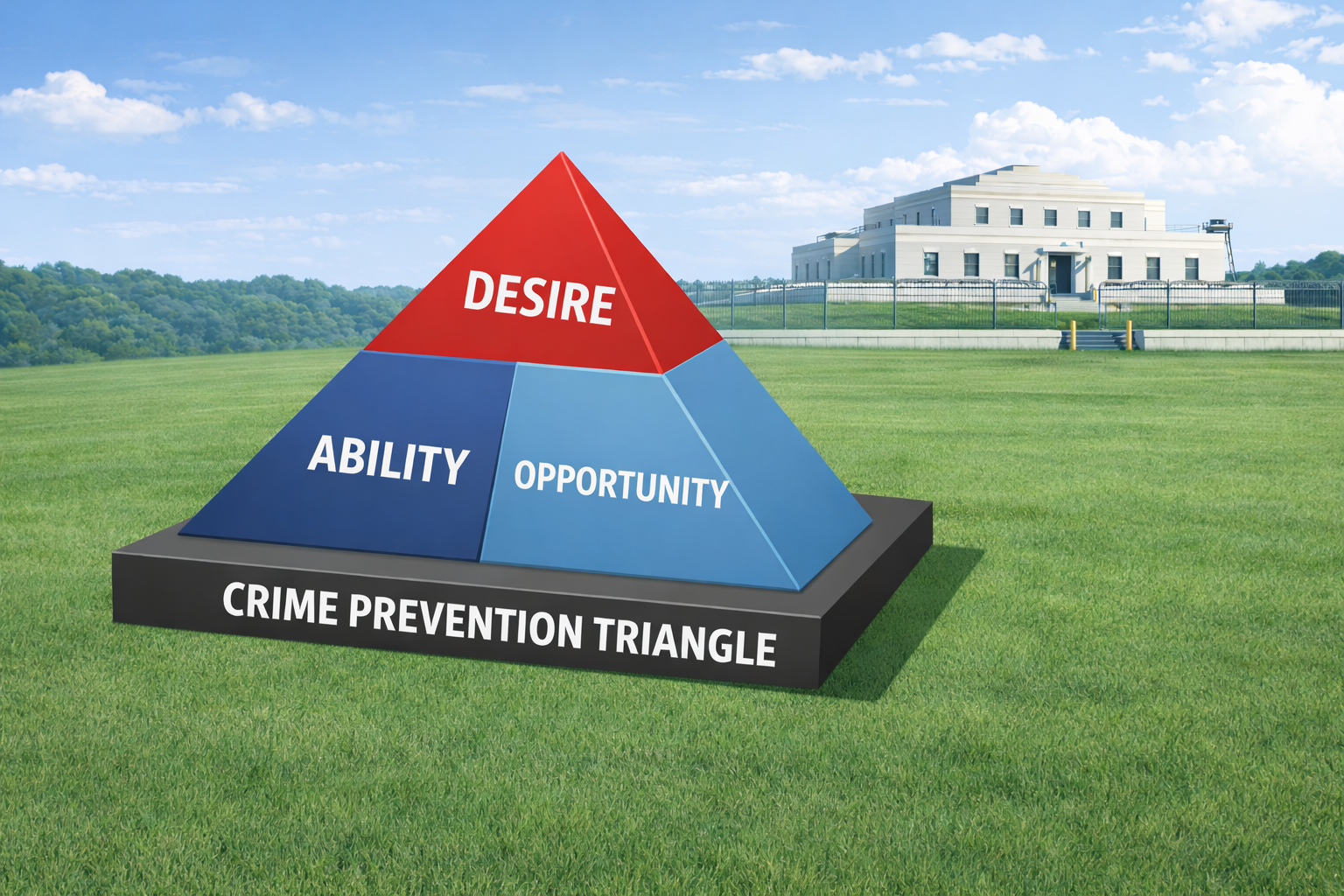
The silent and invisible sentinel guarding Fort Knox. AI generated.
The Crime Prevention Triangle, a framework used by security professionals and law enforcement, teaches that every crime requires three elements: Desire, Ability, and Opportunity. Effective security works by eliminating Opportunity, the only element organizations can reliably control.
When I started my journey studying criminology in college and then crime prevention as a cop, I ran across what is sometimes called the "Crime Prevention Triangle." This is the idea that three things must be present for a crime to occur.
First, there must be a desire to commit the crime. The criminal must want to commit the crime. Second, there must be the ability to commit the crime. The criminal must have the skills and access to do so. Finally, there must be the opportunity to commit the crime. The criminal must be able to act without being stopped.
Desire + Ability + Opportunity = Crime
If any one element is missing, the crime will not occur. To illustrate how the Crime Prevention Triangle works in the real world, I use a couple of examples from opposite ends of the crime spectrum.
Why hasn't anyone stolen from Fort Knox?
In case you are not aware, Fort Knox is (allegedly) filled with the gold reserves of the United States, among other important items the government values. Nestled in the rolling grassy hills of Kentucky is probably enough gold to sink a battleship. Most criminals, and maybe some of you reading this, don't even want the entire stash. Maybe just a bar or two or three or four. I am also sure that most criminals, and again some of you, could physically lift several bars of gold, place them in the back of a vehicle, and drive away. I would argue that most criminals, and maybe most of us, have both the desire and the ability to steal some gold from Fort Knox. But there is one very big problem: we do not have the opportunity.
I will not name all the security features keeping the U.S. bullion safe, but it is protected by armed guards 24 hours a day, alarms, powerful lights, security cameras, and barbed wire fencing, not to mention the gold is stored in a gigantic vault. Unless you have your own army, you are not getting any gold. Two out of three elements might be close, but when it comes to Fort Knox, close still means no gold-plated cigar.
On the flip side, why does anyone pay for a pack of gum at the convenience store?
Almost anyone can pick up a pack of gum and slip it into their pocket. There is ample opportunity to steal it. Just wait for the clerk to get distracted adding hot dogs onto the rollers and claim your loot. But do most people really have the desire to steal a $2.00 pack of gum? Either because they are afraid of the consequences of getting caught or because of their moral compass, most people do the right thing. Like Fort Knox, two out of three means the crime does not take place.
The most important takeaway from the Crime Prevention Triangle is that security usually works by limiting opportunity. We can't control people's desires; that involves controlling someone's thoughts and feelings. Although many people try to affect people's desires, no one has a guaranteed method of changing them. Controlling people's ability can also be a fool's errand. Unless we genetically modify everyone so they can only lift twenty pounds, most adults can pick up a gold bar. The only element we, the good guys, can truly control is eliminating the opportunity for a criminal to victimize us.
The triangle is also used by law enforcement and security professionals to assess new technologies and trends to see if a criminal could use them to victimize innocent people. I am almost embarrassed to admit this as a Crime Prevention Practitioner, but I didn't consciously realize I was using this framework when I first started going down the rabbit hole of drones. It did not hit me that I was using something I had been taught years earlier until I was already deep into exploring CUAS wonderland.
In my next post, I will explain why the Crime Prevention Triangle sparked an obsession with developing strategies to prevent commercial off-the-shelf drones from terrorizing our communities.
Daniel Holland is the co-founder of Crisis Prevention and Response (CPR), a security consulting and training firm that delivers practical security solutions to homes, businesses, schools, houses of worship, and other organizations. He is an active law enforcement officer with over 10 years of experience in investigations, crime prevention, and public safety. He holds Florida Crime Prevention Practitioner and Florida Crime Prevention Through Environmental Design (CPTED) Practitioner designations along with FBI-LEEDA Public Information Officer certification at both levels. He also specializes in emerging threat assessment, with a focus on the drone threat landscape and its implications for civilian organizations.