The Most Important Variable in Security
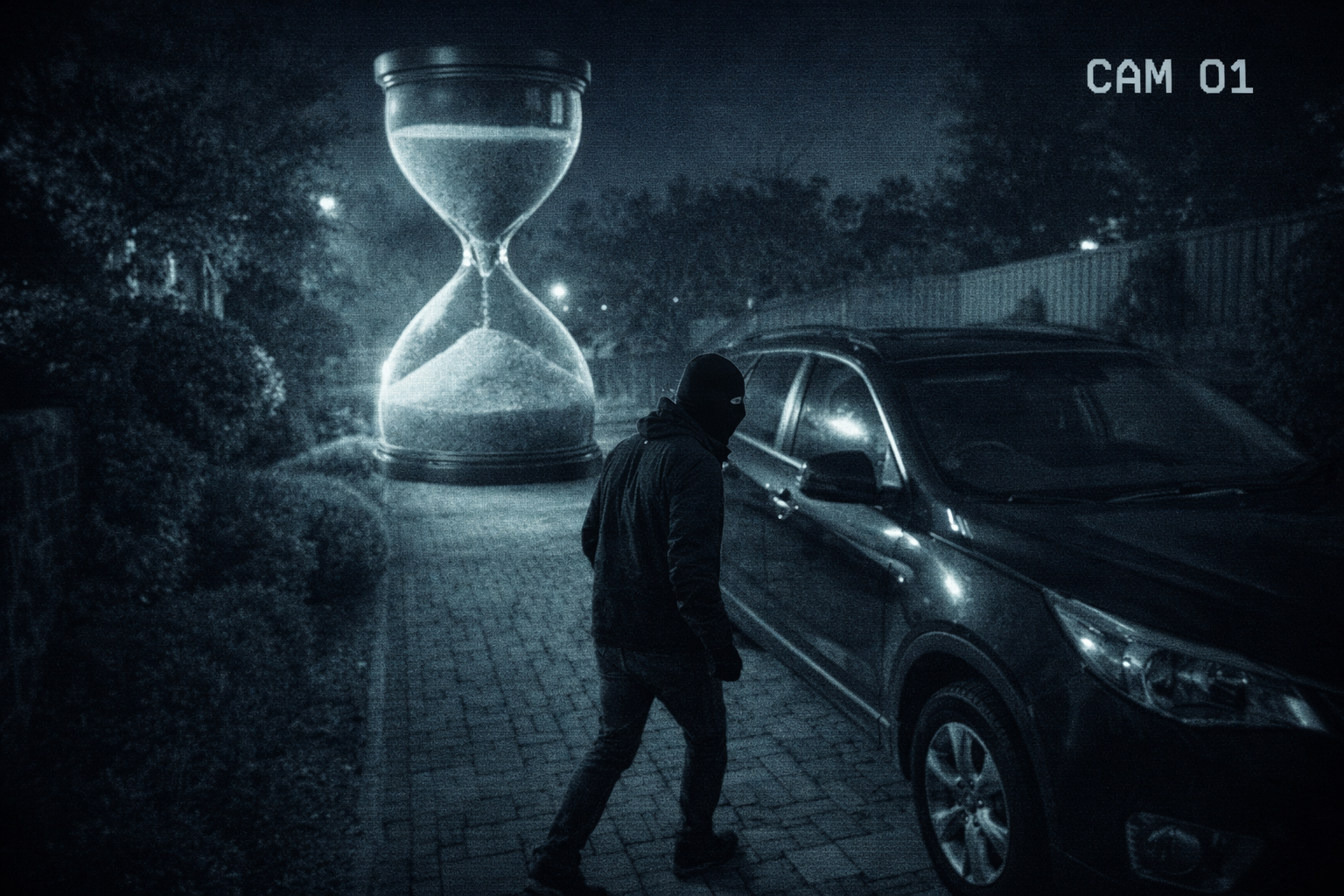
Time is always working against you and the criminal. AI generated.
Every security product and practice serves one purpose: buying time. Time is the most important variable in security, and any lock, camera, alarm, or lighting system should be evaluated by how much time it creates between a threat and its consequence.
Imagine waking up in the morning and discovering your car window smashed and your backpack missing from the passenger seat. Frustrated, you check your security cameras and quickly find the footage. The video clearly shows someone walking up to the car in the middle of the night, breaking the window, grabbing the bag, and leaving.
You now know exactly what happened, but the crime still happened.
Situations like this happen every day. People invest in security hardware expecting it will keep them safe, only to discover their expectations were misguided.
I suggest using one variable that will help you decide if a security product or service is worth your hard-earned money: time. With the vast array of security technology, tools, and training available it can be difficult to know what is effective and what is a waste of money. If you do not have experience in security, it can be even more difficult to decide if this lock or security camera is going to keep you and those you care about safe.
The questions you should ask yourself when evaluating a security product or service are:
Will this make a criminal spend more time getting what they want?
Will this reduce the time it takes for me to spot a criminal?
Will this reduce the time needed to get help?
Every effective security measure ultimately does the same thing: it buys time until help arrives.
If a security product claims to solve one of these problems but the answer is actually “no,” it is probably not improving your security. Like in most aspects of life, time is one of the most important, if not the most important element of success. We can make more money, but you can never make more time. Identifying a bad guy and getting help before the bad guy can get what they want are the basic goals of any security plan. While deterrence is always a goal, in the end it is not up to you if a criminal chooses you as their next victim. That decision lies completely at the feet of the criminal. All we can do is try to detect criminals early or slow them down long enough for help to arrive.
To break this concept down even further, let’s look at some examples of common security hardware that almost everyone has interacted with during the normal course of life.
The Foundations of Security Hardware
The first example we will use are locks. These could be padlocks for a gate, magnetic locks on a hospital emergency room door, or the deadbolt on your front door. Locks are not intended to increase your time to obtain help or reduce the time it takes to identify the bad guy. They are only intended to increase the time it takes for the bad guy to gain access to your stuff. Depending on the quality and type, they can do a very effective job, but they are not designed to keep your belongings completely safe, they are only designed to slow the bad guy down with the hope that they will either pick a different victim or be caught in the act.
Next let’s look at lighting. When used correctly, they help with the identification of bad guys by giving the good guys more opportunities to see a bad guy at night. It is generally not intended to prevent a bad guy from getting what they want or summon help more quickly. But lighting used correctly, focusing light on key locations and reducing glare, should not hinder you in accomplishing those goals.
Finally let’s look at alarms. An alarm is designed to notify you if someone enters your property when the alarm is armed so that you can notify the authorities as soon as possible and catch the bad guys sooner. It is not intended to slow down the bad guys (except annoy them with the loud siren).
Locks, lighting, and alarms are the foundation of security hardware for most homes and businesses for a reason. They answer yes to one of those questions.
The Most Misunderstood Piece of Security Hardware
Finally using this analytical lens, let’s look at one of the most common, but in my opinion misunderstood and misused pieces of security hardware, security cameras. A lot of people think they are a panacea for all security issues. Almost everyone that I conduct security surveys for is eager to show me their camera systems. While I think security cameras are very useful and if you have the budget for them are a worthwhile investment, I also think they provide a false sense of security. Using the three questions above, what do you think the answers are? I would argue the way most people use them, the answer to all three is no. Cameras do not claim to slow a criminal down, so that question is irrelevant. But a lot of people would argue that the answer to the last two questions is yes. I would argue that is incorrect, and that most of the time the answer is actually no.
Many people do not have a live monitoring service for their cameras. This is changing with the rise of AI and computer vision; we are not there yet. Without live monitoring, they are nothing but great evidence collection devices. In the long run they may increase the chances of catching the criminal, but in the short term, unless there is a good guy monitoring the cameras and relaying that information to the relevant authorities, they are not actively increasing the security of your property. Police agencies all over the world have millions of hours of security camera footage showing criminals committing crimes that occurred days before anyone realized a crime had occurred. I have seen many hours of grainy camera footage of criminals breaking into cars that victims only discovered had been burglarized when they saw a broken window as they were about to enter their car to drive to work.
To reiterate, I am not saying security cameras are a waste of time or completely useless. I am only stating what they are designed for, what their capabilities are, and how to use them properly. Just like any other piece of security hardware, if it is misunderstood or used incorrectly, it does not matter how cutting edge or reliable it is. If you don’t lock your door, anyone can get in. If you place an unmonitored camera facing your driveway expecting this will keep your car safe, you are in for a rude awakening.
Time, like in other aspects of life, is the most important element of security. Being able to increase the time it takes a criminal to get what they want, decrease the time it takes to realize someone is committing a crime, and reduce the time it takes to get help should be three of the most important questions you use to evaluate a piece of security hardware.
At Crisis Prevention and Response, one of the services we offer is to help you evaluate the security of your house, office, or organization.
If you would like a professional security survey of your property using this approach coupled with our years of experience, contact us here.
Daniel Holland is the co-founder of Crisis Prevention and Response (CPR), a security consulting and training firm that delivers practical security solutions to homes, businesses, schools, houses of worship, and other organizations. He is an active law enforcement officer with over 10 years of experience in investigations, crime prevention, and public safety. He holds Florida Crime Prevention Practitioner and Florida Crime Prevention Through Environmental Design (CPTED) Practitioner designations along with FBI-LEEDA Public Information Officer certification at both levels. He also specializes in emerging threat assessment, with a focus on the drone threat landscape and its implications for civilian organizations.