How Old-Fashioned Customer Service Makes Your Business More Secure
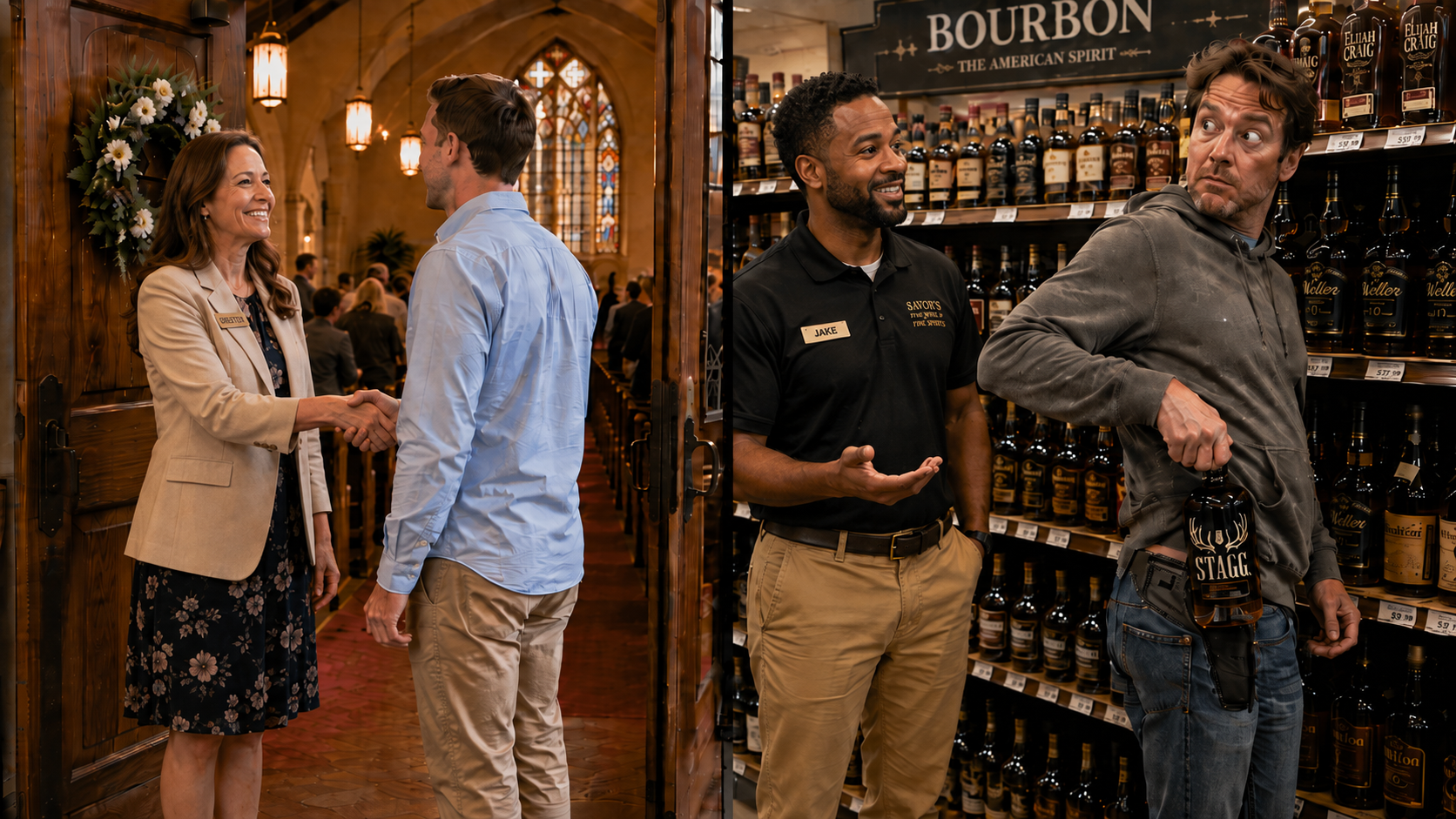
Good customer service can also be good security. A church greeter welcoming a visitor and a retail employee checking in with a customer demonstrate how friendly, proactive engagement can increase awareness, identify unusual behavior, deter misconduct, and strengthen an organization’s overall security plan.
Bottom line: The people who greet your customers are your first layer of security. Attentive, friendly front-line staff remove the anonymity that opportunist criminals depend on, and they usually cost you nothing extra. Good customer service and good security are the same behavior.
Why are front-line staff your most important security asset?
Some of the most important people in any organization's security are the ones who make first contact with the people you serve. The receptionist who checks in patients. The greeter at the church door. The cashier at the convenience store. They are on the front lines, and they are the ones who can catch a problem before it becomes a liability.
These jobs are often filled by some of the lowest-paid workers in the organization. Their pay is rarely commensurate with how important they actually are.
First impressions matter to a successful business. They matter just as much to security.
What does an opportunist criminal actually look for?
Most criminals are looking for easy targets. There are people who set out to victimize a specific individual, but the majority are simply looking for the path of least resistance. That holds true across almost the entire range of crime, from shoplifting all the way up to an active shooter. They want a place where resistance will be minimal.
One of the things an opportunist reads is the attentiveness of your staff. If someone can walk onto your property and move around without being noticed, that is a signal. It tells them your security may be lacking, or at least that there will be a delay before anyone reacts.
Most of us have felt the other side of this. You need help finding something in a giant store, and somehow it seems like nobody works there. And if we are honest, some of us have had the part of our brain that has no rules quietly calculate how much we could walk out with, because no one is watching.
How does simply greeting customers prevent crime?
Now picture the opposite. You walk in and are greeted immediately. As you move through the aisles, another employee comes over and asks if you need help finding anything.
Attentive front-line staff are a key piece of any security plan. Everyone who enters your property should be greeted on the way in. While they are on your property, they should be checked on and asked if they need help. Those points of contact give your organization multiple chances to stop a bad actor, and they show your honest customers that you care about them.
The simple phrase "how can I help you?" works like a charm. It tells the person they have been seen and that you are there to help. It also trains your staff or volunteers to watch the entrances, which matters, because criminals are generally not going to make an entrance like the Kool-Aid man. They are going to come in the front door.
How does this fit into CPTED?
Crime Prevention Through Environmental Design (CPTED) is the practice of shaping a space so that it naturally discourages crime. A lot of CPTED is physical: lighting, sightlines, landscaping. But it also depends on an intangible signal, the aura that someone cares about this place and that people are paying attention to who is here and what they are doing.
Attentive customer service creates exactly that signal at the front door, before anyone spends a dollar on cameras or hardware. It is one of the cheapest and most effective security controls you have.
How should houses of worship apply this?
For a house of worship, this means greeting members, new and old, at more than one point. In a perfect setup there is a greeter in the parking lot, a greeter at the front door, and a greeter at the entrance to the worship space.
I have spoken with members of many different congregations across different faiths, and one thread comes up again and again: the importance of being seen. People have told me they chose their congregation because someone always said hello when they walked in, and someone always came over to talk. Being greeted is why they stayed.
That same warmth is a security layer. Multiple points of contact give you multiple chances to notice a problem, and they tell every visitor that this is a place where people are known and watched over.
What can your organization do starting today?
You do not need a budget or new hardware to start.
Make it a standing rule that every single person who walks through your doors is greeted.
Train staff and volunteers to treat the entrance as their post, not just a doorway.
Have someone make friendly contact with each visitor after they have entered, not only at check-in.
In larger spaces or houses of worship, build in more than one greeting point.
Reward and value your front-line people accordingly. They are doing security work.
Acknowledging your visitors and then checking in on them is customer service 101. In recent years it has become something of a lost art. It is worth doubling down on, not only because it will grow your business, but because it will make you measurably harder to victimize.
Daniel Holland is the co-founder of Crisis Prevention and Response (CPR), a security consulting and training firm that delivers practical security solutions to homes, businesses, schools, houses of worship, and other organizations. He is an active law enforcement officer with over 10 years of experience in investigations, crime prevention, and public safety. He holds Florida Crime Prevention Practitioner and Florida Crime Prevention Through Environmental Design (CPTED) Practitioner designations along with FBI-LEEDA Public Information Officer certification at both levels. He also specializes in emerging threat assessment, with a focus on the drone threat landscape and its implications for civilian organizations.
Frequently asked questions
Does saying hello really stop crime? It removes the anonymity that opportunist criminals rely on. When a visitor is greeted and checked on, they know they have been seen, which raises the perceived risk of getting caught and pushes an opportunist toward an easier target.
How is customer service related to CPTED? CPTED works by signaling that a space is cared for and watched. Attentive, friendly staff create that signal at the entrance, making it one of the lowest-cost, highest-impact security controls available.
What should staff say when greeting a visitor? Something as simple as "how can I help you?" works. It tells the person they have been seen and that help is present, and it trains staff to keep their attention on the entrance.
Do we need to hire security guards to do this? No. This is about training the people you already have, your greeters, cashiers, receptionists, and volunteers, to make consistent, friendly contact with everyone who enters.